Case Study:
Scaling Community Health Access Through Digital Consent Transformation
Large Midwest Federally Qualified Health Center (FQHC)
Situation
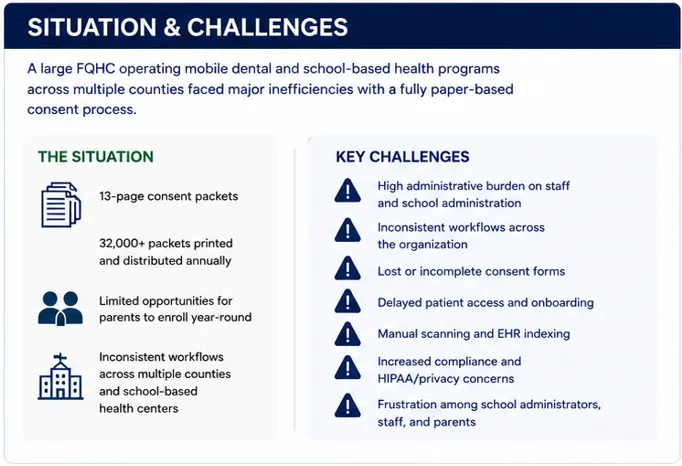
A large Federally Qualified Health Center (FQHC) operating mobile dental and school-based health programs across multiple counties faced significant operational inefficiencies related to patient consent management and access workflows.
The organization relied on a fully paper-based consent process that required printing and distributing approximately 32,000+ multi-page packets to school districts annually. Parents had limited opportunities to enroll their children in mobile and school-based health services, and operational inconsistencies existed across school-based health center workflows.
High administrative burden on staff and school administration
Inconsistent workflows across the organization
Lost documentation
Delayed patient access
Manual scanning requirements
Increased compliance concerns
Frustration among school administrators, staff, and parents
Challenges
Key operational challenges included:
Annual printing and distribution of 13-page paper consent packets
Lack of standardized workflows across school-based health centers
Lost or incomplete paper consent forms
Significant manual administrative work for staff
Delayed patient onboarding and care access
Inability for parents to conveniently enroll children throughout the year
Increased burden on school administrators already experiencing staffing shortages
HIPAA/privacy concerns associated with physical paperwork handling
Manual scanning and indexing of documents into the EHR
Difficulty locating consent documentation for existing or future patients
The paper-based process also created substantial barriers to scaling mobile health operations efficiently.
Operational Approach
As part of a broader operational reboot of the mobile health division coming out of the pandemic, leadership partnered with operational directors, school-based health center managers, and internal stakeholders to redesign the consent process into a unified digital workflow integrated with the organization’s EHR platform (NextGen).
Key Initiatives Included:
Digital “Living Consent” Model
Designed a year-round electronic consent process allowing parents and guardians to submit and request consents at any time rather than during a single annual enrollment window.
QR Code-Based Access Strategy
Implemented QR-code-enabled access points across:
School newsletters
Family communications
Health center materials
Organizational websites
School-based health center locations
This significantly improved accessibility and enrollment convenience for families.
EHR Integration & Consent Database
Developed an internal “Consent Database” within the NextGen EHR environment that centralized:
Patient demographic information
School district affiliation
Service enrollment status
Consent tracking visibility
This enabled staff to verify consent status quickly without navigating full patient charts.
Automated Electronic Workflow
Created a process whereby submitted electronic forms triggered automated delivery of service-specific consent documentation to parents and guardians via email.
The new process supported:
Electronic completion
Digital PDF transfer
Reduced manual scanning
Improved data accuracy
Streamlined onboarding
School Registration Integration
Partnered with school systems to incorporate a “hard stop” question into annual student registration workflows, allowing parents to opt into receiving healthcare service consents electronically during school enrollment.
Results
The redesigned operational workflow generated substantial improvements in efficiency, scalability, and patient access.
Operational & Financial Outcomes
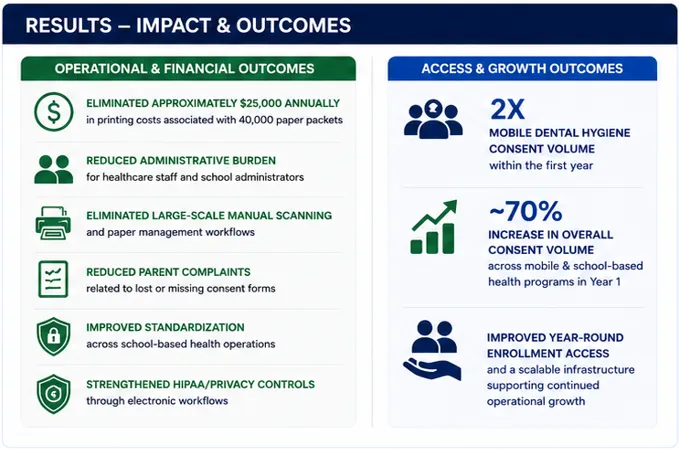
Eliminated approximately $25,000 annually in printing costs associated with 40,000 paper packets
Reduced administrative burden for both healthcare staff and school administrators
Eliminated large-scale manual scanning and paper management workflows
Reduced parent complaints related to lost or missing consent forms
Improved standardization across school-based health operations
Strengthened HIPAA/privacy controls through electronic workflows
Access & Growth Outcomes
Mobile dental hygiene consent volume doubled within the first year
Overall consent volume increased approximately 70% across mobile and school-based health programs in Year 1.
Improved year-round patient enrollment accessibility
Created scalable infrastructure capable of supporting continued operational growth
The operational redesign significantly improved both patient access and organizational scalability while reducing administrative overhead across multiple counties and school districts.
Connect With Dressler Health Advisory
Frequently Asked Questions
Answers to common questions about healthcare operational advisory services, organizational support, consultation engagement, and healthcare growth initiatives.
What types of healthcare organizations does Dressler Health Advisory support?
Dressler Health Advisory works with FQHCs, ambulatory healthcare organizations, multi-site provider groups, and community healthcare systems seeking operational support, workflow modernization, patient access improvement, and sustainable healthcare growth strategies.
What operational challenges can Dressler Health Advisory help address?
Support areas include patient access optimization, healthcare workflow modernization, ambulatory operations leadership, service line stabilization, provider operations support, healthcare expansion strategy, and operational infrastructure improvement initiatives.
Does Dressler Health Advisory provide support for healthcare growth and expansion initiatives?
Yes. Support may include operational planning, workflow strategy, healthcare expansion oversight, infrastructure coordination, patient access scaling, and operational support for organizations pursuing sustainable long-term growth.
How do consultations with Dressler Health Advisory work?
Initial consultations are focused on understanding organizational goals, operational challenges, patient access concerns, and healthcare growth priorities. Following the consultation, strategic recommendations and potential operational support opportunities may be discussed based on the organization’s specific needs.




Get in Touch with us
We’re here to help anytime

Call Us

Mail Us

Opening Time
Mon -Sat: 7:00 - 17:00
Operational healthcare advisory focused on patient access, organizational stability, workflow modernization, and sustainable growth for FQHCs, ambulatory healthcare systems, and community healthcare organizations.
Hours of Operation
9am-5pm
© Copyright 2026 Dressler Health Advisory. All Rights Reserved.
Get in Touch with us
We’re here to help anytime
Call Us
Mail Us
Opening Time
Mon -Sat: 7:00 - 17:00
Operational healthcare advisory focused on patient access, organizational stability, workflow modernization, and sustainable growth for FQHCs, ambulatory healthcare systems, and community healthcare organizations.
Hours of Operation
9am-5pm
© Copyright 2026 Dressler Health Advisory. All Rights Reserved.