
Case Study:
Retina Workflow Redesign & Patient Throughput Optimization
Large Multi-Site Ophthalmology Group
Situation
A large multi-site ophthalmology organization identified significant patient flow inefficiencies and declining patient satisfaction within its high-volume Retina service line at its flagship 114,000 sq. ft. ambulatory facility.
Patients receiving recurring retinal injection treatments for macular degeneration frequently experienced:
Excessive wait times
Inefficient clinic movement
Confusing patient navigation
Delayed testing workflows
Inconsistent throughput
Door-to-door visit times for injection patients regularly exceeded one hour despite these appointments being designed as streamlined, repeatable visits. Negative patient survey feedback and growing patient volumes made operational redesign a strategic priority.
Operational Challenge
Leadership launched a pilot initiative utilizing RFID tracking technology to better understand patient flow, throughput bottlenecks, and clinic inefficiencies throughout the Retina practice.
The project required management of:
RFID hardware implementation
Software integration
Workflow analytics
Operational reporting
Physician and leadership presentations
Vendor coordination
Real-time patient flow monitoring
Over an eight-month pilot period, Retina patients were assigned RFID badges upon check-in, allowing patient movement throughout the 22,000 sq. ft. clinic and testing environment to be mapped and analyzed in real time.
The initiative focused on:
Mapping patient movement
Analyzing throughput by physician and appointment type
Identifying operational bottlenecks
Reducing patient door-to-door times
Improving scheduling efficiency
Supporting long-term Retina growth capacity
Data & Workflow Analysis
Operational data was segmented by:
Key Initiatives Included:
Physician
Appointment type
Day of week
AM/PM clinic sessions
Testing workflows
Patient wait times
Control charts and operational analytics were used to identify areas operating outside acceptable throughput thresholds.
Analysis revealed the organization’s centralized testing department as the primary operational bottleneck.
Retina injection patients were required to:
Complete initial workup
Wait for OCT imaging
Travel to centralized testing
Return to separate waiting areas
Wait again for physician treatment
This workflow created:
30+ minute delays in testing
Congestion across multiple specialties
Excessive patient movement
Confusion among elderly patients
Reduced clinic throughput
Further operational review identified an additional issue:
OCT interpretation billing was not consistently captured, resulting in approximately $40,000 in missed annual revenue.
Operational Redesign
Following operational analysis and direct observation within the testing department, leadership partnered with Retina physicians and clinic leadership to pilot a redesigned injection workflow.
New Workflow Strategy
Rather than routing injection patients through the centralized testing department, OCT imaging equipment was embedded directly into Retina clinic workup lanes.
Technicians were trained to complete imaging during the initial patient workup process, eliminating multiple transition points and reducing patient movement throughout the clinic.
The redesigned workflow simplified the patient journey from:
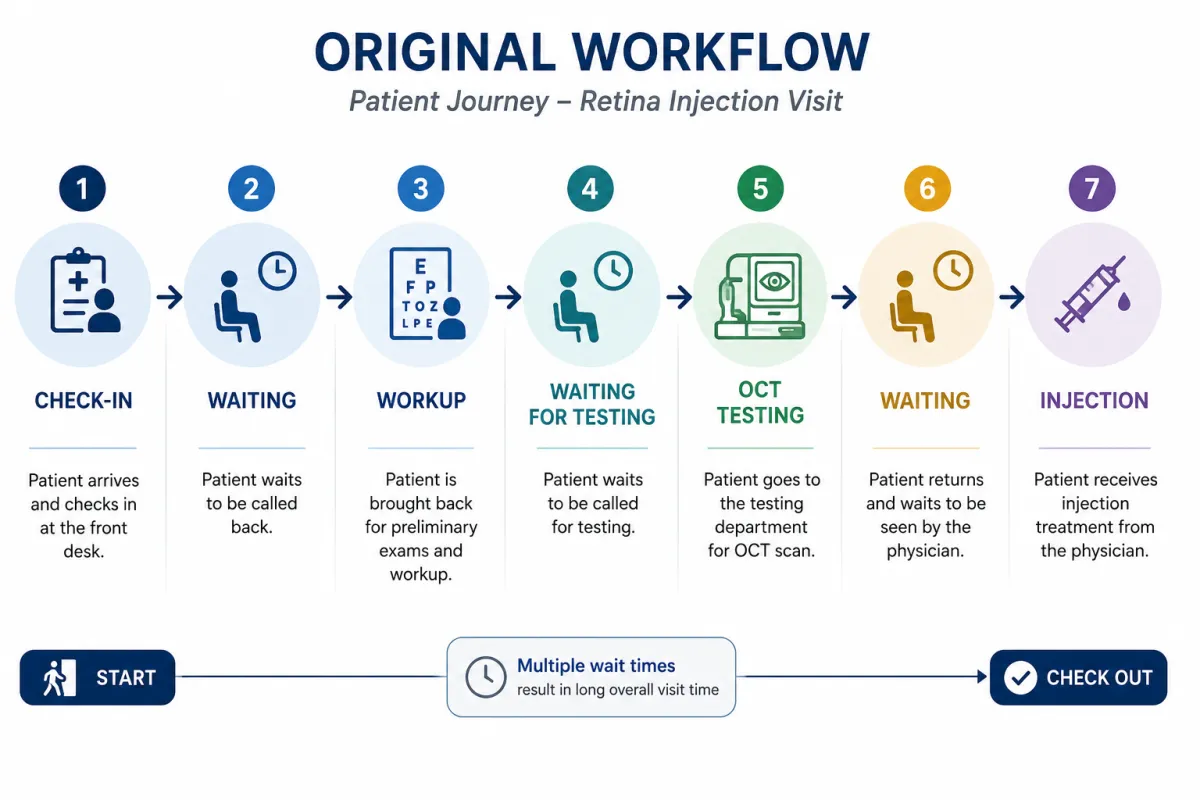
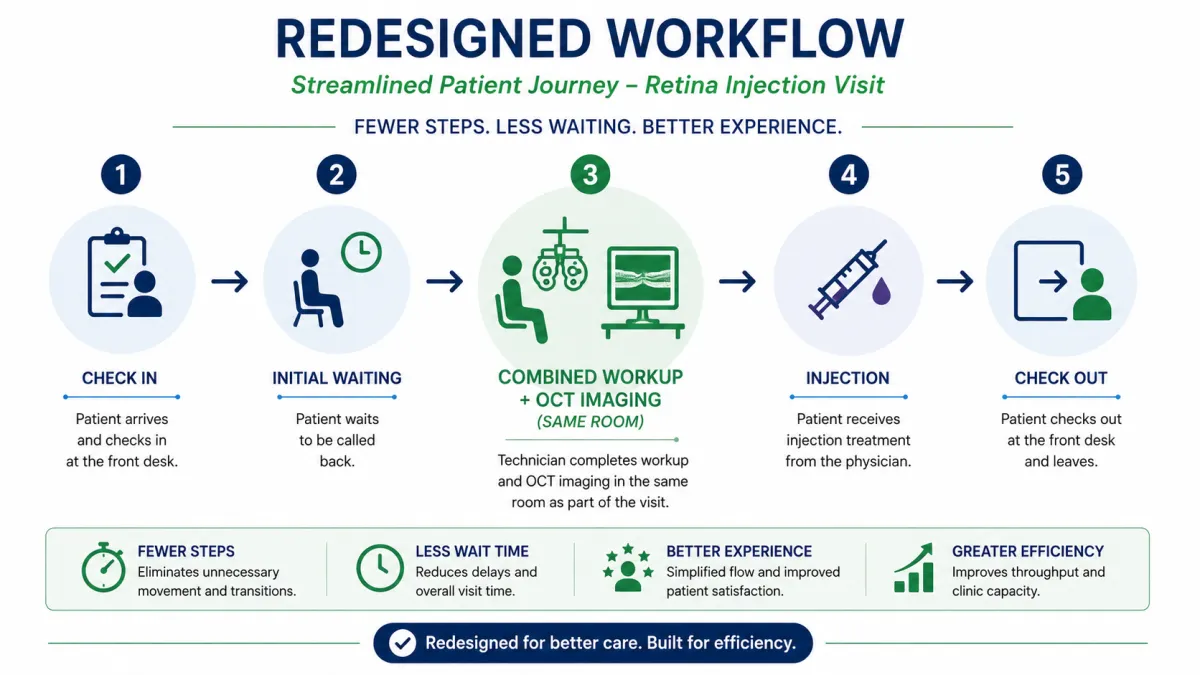
A six-week pilot utilizing temporary OCT equipment was implemented to evaluate operational impact, patient experience, and financial return on investment.
Results
Patient Throughput Improvement
The redesigned workflow produced substantial operational improvements across the Retina service line.
Key Outcomes Included:
Nearly 30% reduction in door-to-door patient visit times
Average injection visit time reduced from approximately 56 minutes to 40 minutes
Elimination of major testing bottlenecks
Reduced patient confusion and unnecessary movement throughout the facility
Improved patient satisfaction and workflow consistency
Operational Efficiency Gains
The redesigned process also created broader organizational benefits by:
Freeing centralized testing department capacity
Reducing congestion across additional ophthalmology subspecialties
Improving throughput throughout the clinic
Optimizing physician scheduling opportunities
Increasing operational scalability for future Retina growth
Workflow redesign additionally allowed leadership to:
Optimize injection scheduling templates
Identify ideal appointment timing
Increase available patient capacity
Reduce operational downtime
Financial Impact
Operational review identified previously missed OCT interpretation billing opportunities, resulting in:
Approximately $40,000 in recovered annual revenue
The workflow redesign and throughput improvements also demonstrated a positive return on investment sufficient to support:
Permanent equipment acquisition
Expansion of the redesigned workflow across all Retina departments company-wide
Key Strategic Outcomes
Leveraged RFID technology to drive operational redesign
Reduced patient visit times by approximately 30%
Identified and eliminated major testing bottlenecks
Improved patient satisfaction and throughput
Increased operational scalability for high-growth Retina services
Improved scheduling efficiency and clinic capacity
Recovered missed procedural revenue opportunities
Successfully implemented redesigned workflows across the organization’s Retina service line
Publication & Industry Recognition
Operational findings and workflow outcomes from this initiative were later published as part of the “AMD Anti-VEGF Workflow Study,” highlighting RFID-based patient flow analysis and specialty clinic throughput optimization within a high-volume Retina practice.
Connect With Dressler Health Advisory
Frequently Asked Questions
Answers to common questions about healthcare operational advisory services, organizational support, consultation engagement, and healthcare growth initiatives.
What types of healthcare organizations does Dressler Health Advisory support?
Dressler Health Advisory works with FQHCs, ambulatory healthcare organizations, multi-site provider groups, and community healthcare systems seeking operational support, workflow modernization, patient access improvement, and sustainable healthcare growth strategies.
What operational challenges can Dressler Health Advisory help address?
Support areas include patient access optimization, healthcare workflow modernization, ambulatory operations leadership, service line stabilization, provider operations support, healthcare expansion strategy, and operational infrastructure improvement initiatives.
Does Dressler Health Advisory provide support for healthcare growth and expansion initiatives?
Yes. Support may include operational planning, workflow strategy, healthcare expansion oversight, infrastructure coordination, patient access scaling, and operational support for organizations pursuing sustainable long-term growth.
How do consultations with Dressler Health Advisory work?
Initial consultations are focused on understanding organizational goals, operational challenges, patient access concerns, and healthcare growth priorities. Following the consultation, strategic recommendations and potential operational support opportunities may be discussed based on the organization’s specific needs.




Get in Touch with us
We’re here to help anytime

Call Us

Mail Us

Opening Time
Mon -Sat: 7:00 - 17:00

Operational healthcare advisory focused on patient access, organizational stability, workflow modernization, and sustainable growth for FQHCs, ambulatory healthcare systems, and community healthcare organizations.
Hours of Operation
9am-5pm
© Copyright 2026 Dressler Health Advisory. All Rights Reserved.
Get in Touch with us
We’re here to help anytime
Call Us
Mail Us
Opening Time
Mon -Sat: 7:00 - 17:00
Operational healthcare advisory focused on patient access, organizational stability, workflow modernization, and sustainable growth for FQHCs, ambulatory healthcare systems, and community healthcare organizations.
Hours of Operation
9am-5pm
© Copyright 2026 Dressler Health Advisory. All Rights Reserved.