
Case Study:
Gastroenterology Service Line Stabilization & Rebuild
Large Integrated Health System
Situation
A large integrated health system faced a significant operational crisis when nearly its entire Gastroenterology (GI) physician group elected to leave the organization and join a national private equity-backed physician practice.
The departure included:
19 Gastroenterology providers
Multiple outpatient clinic locations
Ambulatory Surgery Center (ASC) operations
Hospital call coverage at two major hospitals
The Executive Director responsible for GI operations
The loss of providers created immediate risks related to:
Patient access
Procedural capacity
Hospital coverage
Physician recruitment
Payer contract performance
Financial stability
Continuity of care
Health system leadership engaged a dedicated project management consultant to partner with executive leadership and oversee stabilization and long-term rebuilding efforts for the GI service line.
Operational Challenge
The primary objective was clear:
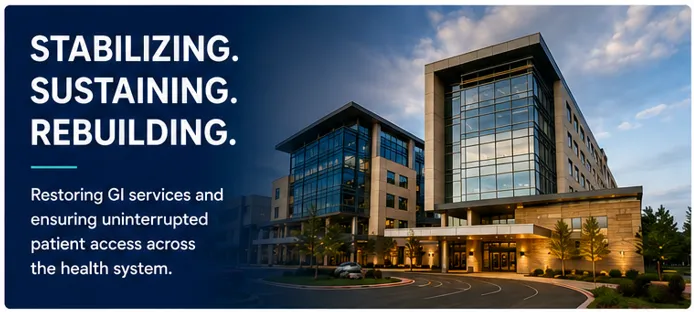
Maintain uninterrupted GI services across the health system while simultaneously rebuilding the department for long-term sustainability.
Key challenges included:
Maintaining clinic access across multiple sites
Preserving endoscopy and procedural volumes
Ensuring continuous hospital call coverage
Managing risk-based payer contracts
Recruiting replacement providers
Coordinating multiple internal and external stakeholders
Stabilizing physician staffing without disrupting patient care
The timeline was immediate, with no opportunity for operational downtime.
Stabilization Strategy
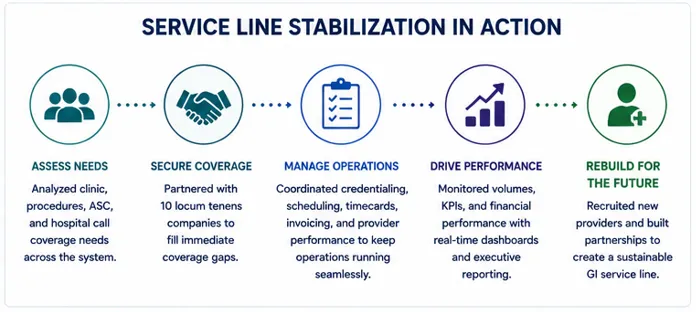
The first phase focused on assessing system-wide coverage requirements.
This included:
Outpatient clinic schedules
ASC procedure schedules
Hospital call/ inpatient coverage
Provider productivity requirements
Staffing gaps across all locations
Working closely with executive leadership, legal counsel, physician leadership, and operational stakeholders, a comprehensive locum tenens coverage strategy was developed to ensure uninterrupted patient care.
Locum Tenens Coverage Program
To rapidly stabilize the service line, partnerships were established with multiple national locum tenens organizations.
Responsibilities included:
Contract Development & Negotiation
Creation of standardized contract templates
Vendor negotiations
Coverage rate management
Service-level expectations
Provider Onboarding
Credentialing
Medical Staff approval
Payor enrollment
State licensure coordination
Scheduling and deployment
Ongoing Program Management
Timesheet approvals
Invoice management
Provider performance monitoring
Coverage coordination
Over the course of the project:
Key Metrics
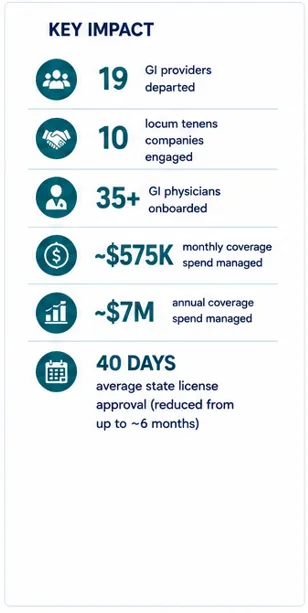
10 locum tenens firms engaged
35+ GI physicians onboarded
Approximately $575,000 monthly coverage spend managed
Approximately $7 million annual physician coverage budget administered
State Licensure Acceleration Initiative
One of the most significant barriers involved obtaining state medical licenses for incoming physicians.
At the time:
COVID-related staffing shortages existed
Ohio was transitioning licensing platforms
Standard approval timelines approached six months
Such delays would have severely impacted the stabilization effort.
To address this issue, direct relationships were developed with:
State licensing officials
Regulatory stakeholders
Local state representatives
These efforts successfully reduced physician licensing timelines from approximately six months to roughly 40 days after complete application submission.
This initiative became a critical factor in maintaining adequate physician coverage throughout the stabilization process.
Operational Coordination & Communication
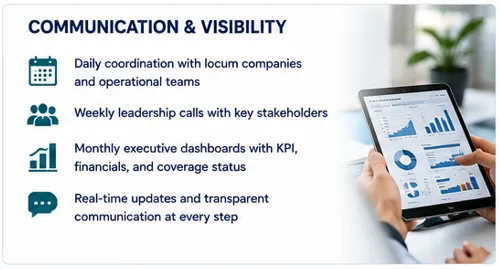
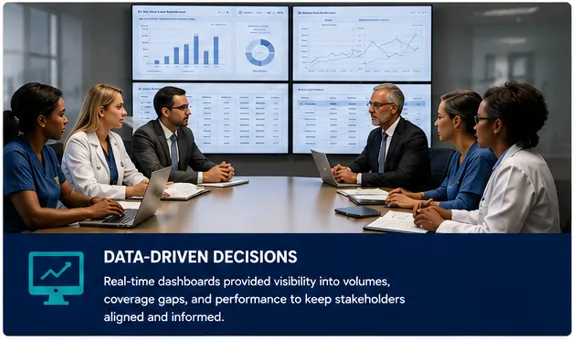
A centralized communication model was established to ensure all stakeholders had real-time visibility into service line performance and physician coverage.
This included:
Daily Coordination
Locum tenens firms
Scheduling teams
Credentialing teams
Medical Staff offices
Hospital leadership
Weekly Leadership Meetings
System leadership
Hospital leadership
ASC leadership
Service line leadership
Nursing leadership
Monthly Executive Reporting
Clinic volume performance
Procedure volumes
Budget performance
Coverage status
Recruitment progress
Operational risks
Custom Excel-based coverage dashboards were developed to provide visibility into:
Active physician coverage
Scheduling gaps
Site-specific staffing needs
Future coverage risks
These dashboards became the primary operational management tool for stakeholders across the system.
Recruitment & Long-Term Rebuild
While stabilization efforts were underway, leadership simultaneously pursued long-term rebuilding strategies.
Initiatives included:
Physician recruitment efforts
Candidate interviews
Partnership discussions with independent GI groups
Evaluation of joint venture opportunities
Conversion of high-performing locum physicians into employed providers
These efforts ultimately resulted in:
Recruitment Outcomes
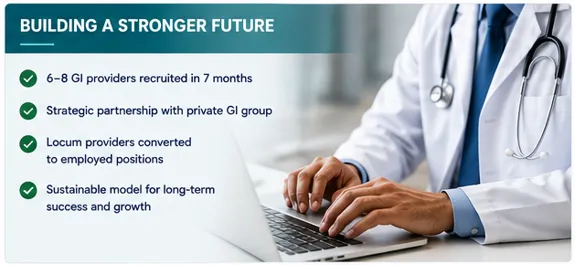
6–8 Gastroenterologists hired within approximately seven months
Strategic partnership with a private GI group
Multiple providers transitioning into employed physician roles
Reduced dependency on locum coverage over time
Results
Service Line Stabilization
Despite the departure of nearly the entire physician group:
Key Outcomes
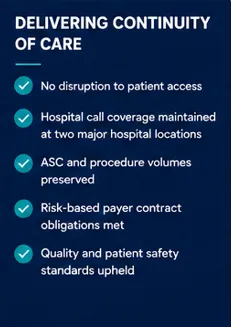
No clinical downtime across GI services
Continuous patient access maintained
Hospital call coverage preserved
ASC procedural capacity maintained
Risk-based payer contract obligations met
Consistent stakeholder communication maintained
Physician quality standards upheld
Operational Performance
The stabilization strategy enabled the organization to:
Maintain clinic and procedural operations
Preserve patient continuity of care
Meet volume targets with minimal disruption
Reduce operational uncertainty
Build sustainable physician staffing models
Transition from crisis management to long-term growth planning
Within approximately two years, the service line successfully transitioned from emergency stabilization to a sustainable operating model supported by employed physicians, strategic partnerships, and targeted use of locum tenens providers. Ongoing recruitment efforts have eased the burden on locum tenens providers.
Strategic Impact
The GI service line stabilization initiative demonstrated the ability to manage complex healthcare operational crises while maintaining patient care, physician coverage, and financial performance.
The project required coordination across:
Executive leadership
Physician leadership
Legal teams
Credentialing departments
Medical staff offices
Payor contracting teams
Recruitment teams
Locum tenens organizations
Hospital operations
While balancing both immediate stabilization needs and long-term strategic growth objectives.
Key Strategic Outcomes
Stabilized a GI service line following the departure of 19 physicians
Managed approximately $7M in annual locum tenens coverage spend
Coordinated onboarding of 35+ GI physicians
Accelerated state licensure approvals from approximately six months to 40 days
Executed contracts with 10 locum tenens organizations
Recruited 6–8 permanent Gastroenterologists within seven months
Maintained continuous patient access and hospital coverage
Preserved procedural capacity and payer contract performance
Successfully transitioned the service line from crisis stabilization to long-term sustainability
Connect With Dressler Health Advisory
Frequently Asked Questions
Answers to common questions about healthcare operational advisory services, organizational support, consultation engagement, and healthcare growth initiatives.
What types of healthcare organizations does Dressler Health Advisory support?
Dressler Health Advisory works with FQHCs, ambulatory healthcare organizations, multi-site provider groups, and community healthcare systems seeking operational support, workflow modernization, patient access improvement, and sustainable healthcare growth strategies.
What operational challenges can Dressler Health Advisory help address?
Support areas include patient access optimization, healthcare workflow modernization, ambulatory operations leadership, service line stabilization, provider operations support, healthcare expansion strategy, and operational infrastructure improvement initiatives.
Does Dressler Health Advisory provide support for healthcare growth and expansion initiatives?
Yes. Support may include operational planning, workflow strategy, healthcare expansion oversight, infrastructure coordination, patient access scaling, and operational support for organizations pursuing sustainable long-term growth.
How do consultations with Dressler Health Advisory work?
Initial consultations are focused on understanding organizational goals, operational challenges, patient access concerns, and healthcare growth priorities. Following the consultation, strategic recommendations and potential operational support opportunities may be discussed based on the organization’s specific needs.




Get in Touch with us
We’re here to help anytime

Call Us

Mail Us

Opening Time
Mon -Sat: 7:00 - 17:00

Operational healthcare advisory focused on patient access, organizational stability, workflow modernization, and sustainable growth for FQHCs, ambulatory healthcare systems, and community healthcare organizations.
Hours of Operation
9am-5pm
© Copyright 2026 Dressler Health Advisory. All Rights Reserved.
Get in Touch with us
We’re here to help anytime
Call Us
Mail Us
Opening Time
Mon -Sat: 7:00 - 17:00
Operational healthcare advisory focused on patient access, organizational stability, workflow modernization, and sustainable growth for FQHCs, ambulatory healthcare systems, and community healthcare organizations.
Hours of Operation
9am-5pm
© Copyright 2026 Dressler Health Advisory. All Rights Reserved.