Case Study: Multi-County Mobile Health Expansion & Community Access Growth
Large Midwest FQHC
Situation
A large Midwest Federally Qualified Health Center (FQHC) sought to expand access to dental and vision services across underserved rural communities with limited provider availability, long wait times, and significant barriers to care.
At the time, the organization operated a single mobile preventative dental team with limited regional reach. Access challenges across the region included:
Shortage of Medicaid dental providers
Travel barriers for families
Limited specialty access
Extended wait times for treatment 6+ months
Lack of pediatric vision resources especially for uninsured and Medicaid
Inconsistent outreach and enrollment infrastructure
The organization required a scalable operational strategy capable of supporting sustainable regional growth while improving patient access across multiple rural counties.
Case Study: Multi-County Mobile Health Expansion & Community Access Growth
Large Midwest FQHC
Situation
A large Midwest Federally Qualified Health Center (FQHC) sought to expand access to dental and vision services across underserved rural communities with limited provider availability, long wait times, and significant barriers to care.
At the time, the organization operated a single mobile preventative dental team with limited regional reach. Access challenges across the region included:
Shortage of Medicaid dental providers
Travel barriers for families
Limited specialty access
Extended wait times for treatment 6+ months
Lack of pediatric vision resources especially for uninsured and Medicaid
Inconsistent outreach and enrollment infrastructure
The organization required a scalable operational strategy capable of supporting sustainable regional growth while improving patient access across multiple rural counties.
Operational Strategy
Following implementation of a redesigned digital consent and outreach infrastructure, leadership leveraged the new operational framework to support large-scale regional expansion of mobile healthcare services.
The newly developed QR-based digital enrollment process functioned not only as a consent tool, but also as a scalable marketing and communication platform that strengthened relationships with school districts and simplified patient access across the organization’s service area.
Mobile Dental Expansion
Recognizing significant unmet treatment needs in rural communities, leadership developed and launched additional mobile dental treatment capabilities designed to function as a local safety-net resource for pediatric Medicaid populations.
Operational initiatives included:
Expansion from preventative-only services into comprehensive treatment services
Creation of integrated referral pathways between hygiene and treatment teams
Staffing development for non-sedation pediatric treatment workflows
Coordination with brick-and-mortar dental locations for complex referrals
Deployment planning across multiple counties and school districts
The new structure allowed students to receive treatment directly at school, reducing transportation barriers and minimizing work disruption for parents and guardians. It also allowed for more immediate care for students bypassing the 6+ month wait at local Children’s Hospitals.
Operational Strategy
Following implementation of a redesigned digital consent and outreach infrastructure, leadership leveraged the new operational framework to support large-scale regional expansion of mobile healthcare services.
The newly developed QR-based digital enrollment process functioned not only as a consent tool, but also as a scalable marketing and communication platform that strengthened relationships with school districts and simplified patient access across the organization’s service area.
Mobile Dental Expansion
Recognizing significant unmet treatment needs in rural communities, leadership developed and launched additional mobile dental treatment capabilities designed to function as a local safety-net resource for pediatric Medicaid populations.
Operational initiatives included:
Expansion from preventative-only services into comprehensive treatment services
Creation of integrated referral pathways between hygiene and treatment teams
Staffing development for non-sedation pediatric treatment workflows
Coordination with brick-and-mortar dental locations for complex referrals
Deployment planning across multiple counties and school districts
The new structure allowed students to receive treatment directly at school, reducing transportation barriers and minimizing work disruption for parents and guardians. It also allowed for more immediate care for students bypassing the 6+ month wait at local Children’s Hospitals.
Mobile Vision Program Launch
During community outreach efforts, school systems and local stakeholders identified significant unmet pediatric vision needs throughout the region. Students who failed school-based vision screenings frequently lacked access to follow-up eye exams.
Leveraging prior ophthalmology and optometry operational experience, leadership designed and launched the organization’s first mobile vision program focused on:
Comprehensive eye exams
School-based vision access
Glasses dispensing
Integration with school screening workflows
Follow-up referral coordination
Strategic partnerships were developed with an in-state lab to provide low-cost, high-quality glasses with warranty support while maintaining affordability for underserved populations.
Grant funding was successfully secured to support:
Equipment acquisition
Mobile infrastructure
Vehicle deployment
Operational startup costs
Ensured all students received glasses regardless of ability to pay
Mobile Vision Program Launch
During community outreach efforts, school systems and local stakeholders identified significant unmet pediatric vision needs throughout the region. Students who failed school-based vision screenings frequently lacked access to follow-up eye exams.
Leveraging prior ophthalmology and optometry operational experience, leadership designed and launched the organization’s first mobile vision program focused on:
Comprehensive eye exams
School-based vision access
Glasses dispensing
Integration with school screening workflows
Follow-up referral coordination
Strategic partnerships were developed with an in-state lab to provide low-cost, high-quality glasses with warranty support while maintaining affordability for underserved populations.
Grant funding was successfully secured to support:
Equipment acquisition
Mobile infrastructure
Vehicle deployment
Operational startup costs
Ensured all students received glasses regardless of ability to pay
Results
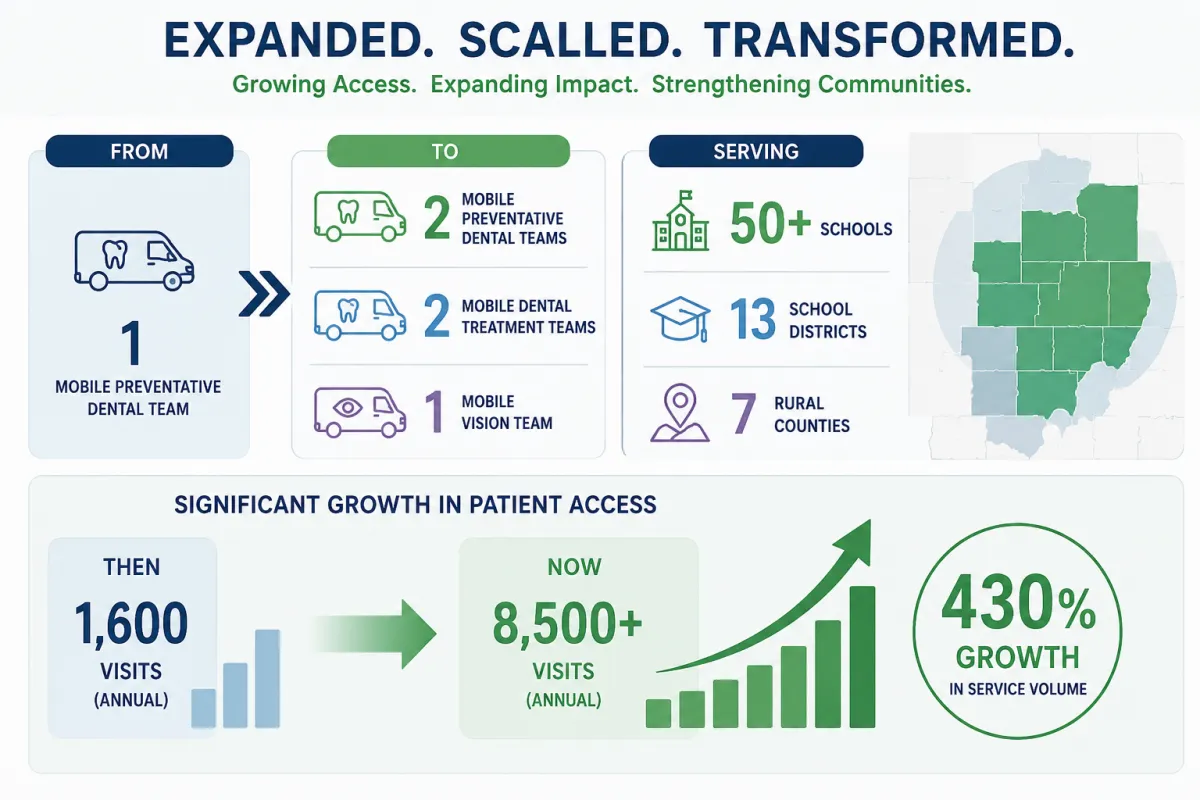
Regional Operational Growth (3-Year Expansion)
Results
Regional Operational Growth (3-Year Expansion)
Mobile Vision Outcomes
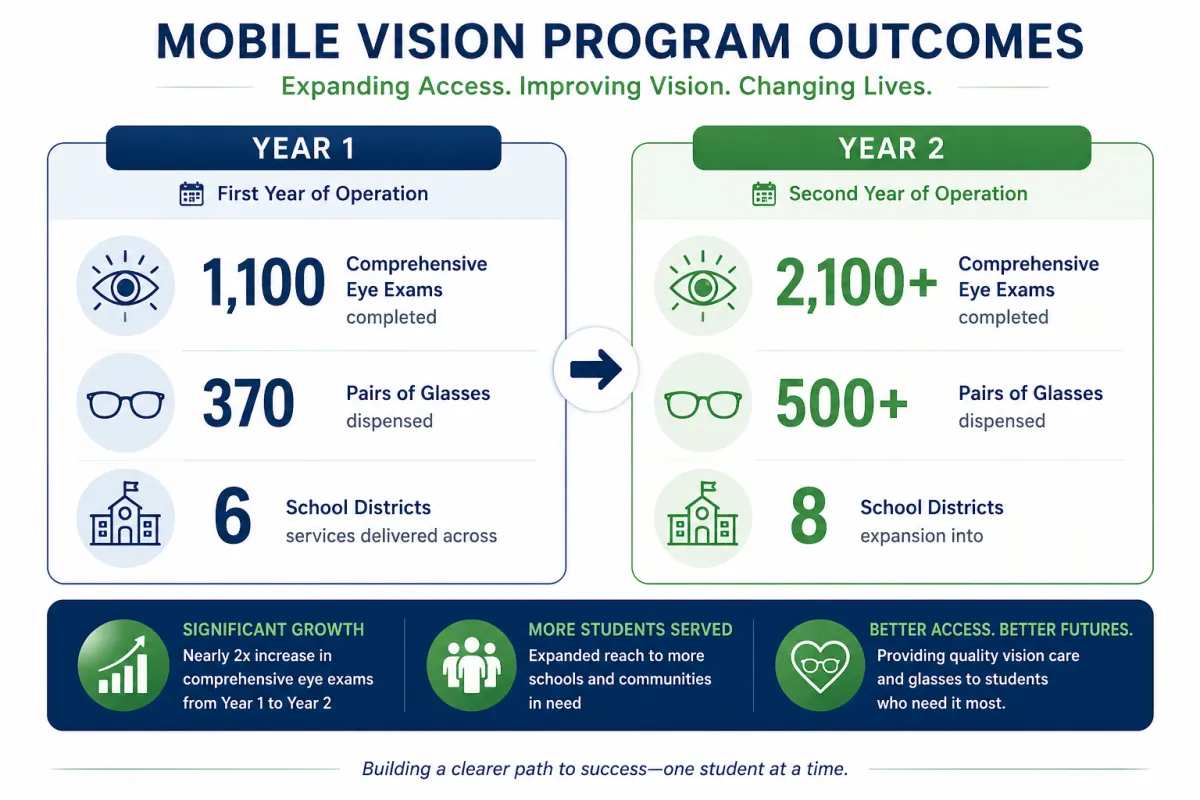
Mobile Vision Outcomes
Mobile Dental Treatment Outcomes
Year 1
1,220+ completed dental treatments
Year 2
Nearly 1,300 completed treatments
Full treatment plan completion increased from 15% to more than 35%
Mobile Dental Treatment Outcomes
Year 1
1,220+ completed dental treatments
Year 2
Nearly 1,300 completed treatments
Full treatment plan completion increased from 15% to more than 35%
Community Impact
The expanded mobile health infrastructure significantly improved healthcare accessibility for underserved rural populations by:
Reducing transportation barriers
Minimizing missed work for families
Improving school-based access to care
Expanding Medicaid treatment availability
Increasing access to pediatric dental and vision services
Operational growth also enabled year-round community engagement through partnerships with rural health districts and expansion into fixed-site pediatric vision services.
The success of the mobile vision initiative ultimately led to invitations to present operational insights and program outcomes to Ohio state leaders through the OhioSEE initiative focused on improving pediatric vision access statewide.
Community Impact
The expanded mobile health infrastructure significantly improved healthcare accessibility for underserved rural populations by:
Reducing transportation barriers
Minimizing missed work for families
Improving school-based access to care
Expanding Medicaid treatment availability
Increasing access to pediatric dental and vision services
Operational growth also enabled year-round community engagement through partnerships with rural health districts and expansion into fixed-site pediatric vision services.
The success of the mobile vision initiative ultimately led to invitations to present operational insights and program outcomes to Ohio state leaders through the OhioSEE initiative focused on improving pediatric vision access statewide.
Key Strategic Outcomes
Built scalable regional mobile healthcare infrastructure
Expanded healthcare access across underserved rural communities
Created integrated referral pathways across mobile and fixed-site services
Improved treatment completion and continuity of care
Leveraged digital infrastructure to support operational scaling
Established sustainable growth model for community-based healthcare delivery
Key Strategic Outcomes
Built scalable regional mobile healthcare infrastructure
Expanded healthcare access across underserved rural communities
Created integrated referral pathways across mobile and fixed-site services
Improved treatment completion and continuity of care
Leveraged digital infrastructure to support operational scaling
Established sustainable growth model for community-based healthcare delivery
Connect With Dressler Health Advisory
Frequently Asked Questions
Answers to common questions about healthcare operational advisory services, organizational support, consultation engagement, and healthcare growth initiatives.
What types of healthcare organizations does Dressler Health Advisory support?
Dressler Health Advisory works with FQHCs, ambulatory healthcare organizations, multi-site provider groups, and community healthcare systems seeking operational support, workflow modernization, patient access improvement, and sustainable healthcare growth strategies.
What operational challenges can Dressler Health Advisory help address?
Support areas include patient access optimization, healthcare workflow modernization, ambulatory operations leadership, service line stabilization, provider operations support, healthcare expansion strategy, and operational infrastructure improvement initiatives.
Does Dressler Health Advisory provide support for healthcare growth and expansion initiatives?
Yes. Support may include operational planning, workflow strategy, healthcare expansion oversight, infrastructure coordination, patient access scaling, and operational support for organizations pursuing sustainable long-term growth.
How do consultations with Dressler Health Advisory work?
Initial consultations are focused on understanding organizational goals, operational challenges, patient access concerns, and healthcare growth priorities. Following the consultation, strategic recommendations and potential operational support opportunities may be discussed based on the organization’s specific needs.




Get in Touch with us
We’re here to help anytime

Call Us

Mail Us

Opening Time
Mon -Sat: 7:00 - 17:00
Operational healthcare advisory focused on patient access, organizational stability, workflow modernization, and sustainable growth for FQHCs, ambulatory healthcare systems, and community healthcare organizations.
Hours of Operation
9am-5pm
© Copyright 2026 Dressler Health Advisory. All Rights Reserved.
Get in Touch with us
We’re here to help anytime
Call Us
Mail Us
Opening Time
Mon -Sat: 7:00 - 17:00
Operational healthcare advisory focused on patient access, organizational stability, workflow modernization, and sustainable growth for FQHCs, ambulatory healthcare systems, and community healthcare organizations.
Hours of Operation
9am-5pm
© Copyright 2026 Dressler Health Advisory. All Rights Reserved.